


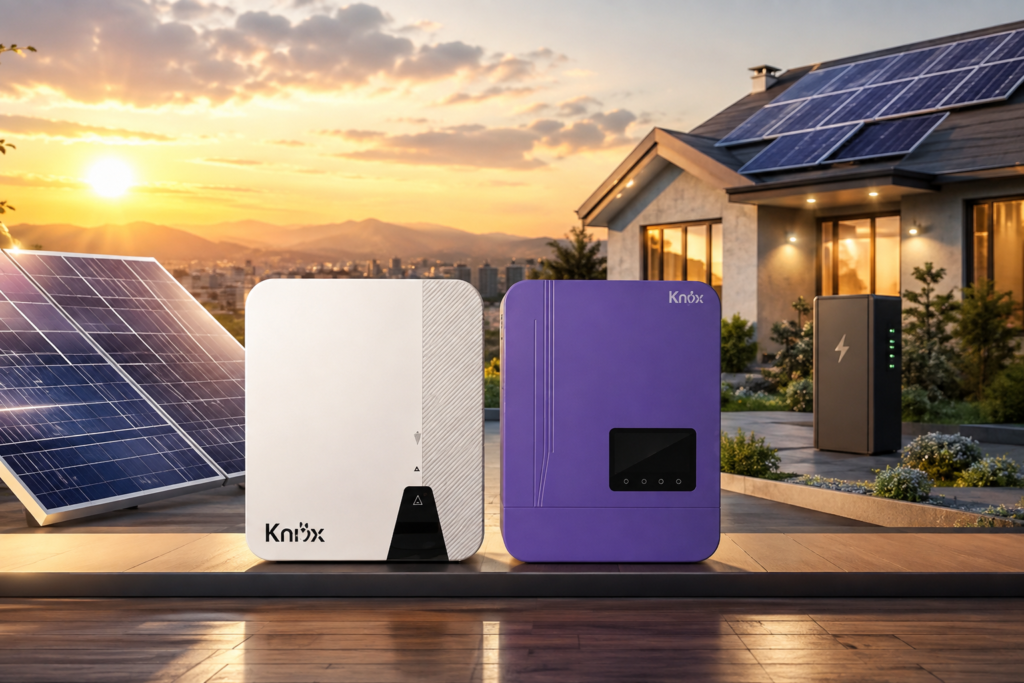
Pakistan’s power situation has pushed more homeowners and businesses toward solar than ever before, but the inverter you choose matters just as much as the panels you install. Knox Solar, a Pakistan-based solar energy brand, has built its Krypton series around one idea: give people flexible, intelligent inverters that adapt to unstable grid conditions instead of forcing them to pick between “always on grid” and “always off grid.”
This guide breaks down what the Knox Krypton lineup actually offers, how hybrid, on-grid, and off-grid inverters differ, and how to figure out which configuration fits your home or business.
What Is the Knox Krypton Series?
The Krypton series is Knox Solar’s flagship inverter lineup, ranging from smaller 4kW residential units up to 11kW+ models built for larger homes and commercial setups. Across the range, the inverters share a common design philosophy: dual MPPT solar charging, wide DC input voltage windows (commonly 90V to 450–500V), built-in Wi-Fi for remote monitoring through a mobile app, and the ability to run with or without a battery connected.
That last point is worth highlighting. Many older inverter designs stop working the moment a battery is disconnected or fails. Krypton units are built with “battery-independent” operation, meaning solar and grid power keep flowing to your home even if there’s no battery in the system or the battery has been temporarily removed for servicing.
Hybrid Inverters The Core of the Krypton Lineup
Most Krypton models including the Krypton 6000, Krypton Eco 6600, Krypton 8000, Krypton 9055, Krypton 12002, and Krypton 13000 are hybrid inverters. A hybrid inverter is designed to draw power from three sources depending on availability and priority: solar panels, a battery bank, and the utility grid.
How a hybrid Krypton inverter behaves day to day
During daylight hours, the inverter prioritizes solar generation, using it to run the household load first and send any surplus to charge the connected battery. Once the battery reaches its set capacity, or if there’s no battery installed, excess solar can be configured to flow toward supplying additional loads or simply capped, depending on the model’s export settings. When solar output drops at night, during cloudy weather, or during peak load spikes the system automatically switches to battery power, and if the battery is also depleted, it draws from the grid so the home never loses power.
Key features across Krypton hybrid models
- Dual MPPT charge controllers that track two separate solar strings independently, useful when panels face different directions or receive different amounts of shade throughout the day.
- Wide PV input voltage range, typically 90VDC to 450–500VDC, which allows a broad mix of panel configurations and string sizes.
- Battery flexibility, supporting both lithium and lead-acid battery banks at 48V nominal in most models, with configurable charge currents.
- Dual AC outputs on higher-capacity models (such as the Krypton 12002), letting you separate priority loads like lights, routers, and fans from heavier appliances that only run when solar or battery capacity allows.
- RS485, CAN-BUS, and RS232 communication ports for BMS (Battery Management System) integration, which matters if you’re pairing the inverter with a smart lithium battery pack.
- Remote monitoring via a companion Android/iOS app over built-in Wi-Fi, so system owners can check generation, consumption, and battery state without walking outside to check an LCD screen.
- Parallel operation support, with some models allowing up to 6–9 units to be linked together for larger commercial installations.
Who should choose a hybrid Krypton inverter
If your priority is reducing electricity bills while keeping a safety net during load-shedding, a hybrid inverter is generally the right call. It gives you the best of both worlds: you’re not fully dependent on the grid, but you’re also not stuck without power on a string of cloudy days, since the grid remains available as a backup source.
On-Grid Inverters: Built for Maximum Solar Export
Knox also offers dedicated on-grid (grid-tied) inverters, such as the Krypton G4 PRO, aimed at users who don’t need battery backup and instead want to maximize the return on their solar investment by feeding surplus power back into the grid under net-metering arrangements.
How on-grid inverters differ from hybrid units
An on-grid inverter has no battery input at all. It synchronizes directly with grid frequency and voltage, converting DC power from your solar panels into AC power that’s consumed on-site or exported to the utility company. Because there’s no battery charging circuitry to manage, on-grid inverters tend to be simpler, more efficient at converting solar to usable AC power, and less expensive than a comparable hybrid unit.
The tradeoff is straightforward: when the grid goes down, an on-grid inverter shuts off too, by design, as a safety measure to prevent “islanding” (feeding power into grid lines that utility workers may be repairing). That means no backup power during outages unless the system is later upgraded with a hybrid unit or separate backup source.
Who should choose an on-grid Krypton inverter
On-grid setups make the most sense for areas with reasonably stable grid supply and access to net metering, where the financial goal is offsetting daytime electricity consumption and exporting extra units for bill credit. Commercial and industrial (C&I) users with large rooftop or ground-mount arrays, and predictable daytime consumption, are typically the strongest fit for this category.
Off-Grid Capability: Independence from the Utility Grid
While Knox doesn’t heavily market a separate “off-grid only” product line the way some legacy brands do, the Krypton hybrid inverters are engineered to support full off-grid operation as one of their selectable modes. In practice, this means a Krypton hybrid unit can run a home entirely on solar and battery power with the grid connection disabled or unavailable useful for areas with no grid access, or for users who simply want to disconnect from the utility completely.
What off-grid mode requires
Running truly off-grid successfully depends less on the inverter itself and more on correctly sizing the rest of the system:
- Battery capacity large enough to carry the home through the night and through at least one or two cloudy days without solar input.
- Panel array size calculated to fully recharge the battery bank during available daylight hours, not just meet daytime load.
- Realistic load planning, since heavy inductive loads (air conditioners, motors, pumps) draw high surge currents that the inverter’s surge rating must be able to handle.
Knox Krypton inverters list surge power ratings well above their continuous rated output (for example, a 6.2kW continuous unit rated near 12,400VA surge), which is specifically meant to handle the startup spike of compressors and motors without tripping.
Who should choose off-grid operation
This mode fits areas with unreliable, expensive, or entirely absent grid connections rural properties, remote commercial sites, or anyone prioritizing complete energy independence over the convenience of grid backup.
Hybrid vs On-Grid vs Off-Grid A Quick Comparison
Factor | Hybrid (Krypton Series) | On-Grid (e.g., G4 PRO) | Off-Grid (Krypton, off-grid mode) |
Battery required | Optional | No | Yes |
Works during power outage | Yes, via battery | No | Yes, independent of grid |
Net metering / grid export | Possible, model-dependent | Yes, primary use case | Not applicable |
Upfront cost | Moderate to higher | Lower | Higher (due to battery bank) |
Best for | Homes wanting savings + backup | Businesses maximizing export credit | Remote or grid-independent sites |
Practical Buying Considerations
Before settling on a specific Krypton model, it helps to work backward from your actual electricity usage rather than the inverter’s marketing capacity number.
- Add up your essential daily load lights, fans, refrigerator, internet router, and any must-run appliances and compare that to the inverter’s rated (continuous) output, not just its surge or peak figure.
- Check the PV input window against your panel string configuration. A wide input range like 90–450VDC gives more flexibility, but your installer still needs to calculate string voltage against local temperature swings.
- Decide on battery chemistry early. Lithium batteries generally offer longer cycle life and better BMS communication with Krypton inverters via RS485/CAN-BUS, while lead-acid remains a lower-cost entry option.
- Confirm parallel and dual-output support if you’re scaling up. Larger households or small commercial sites benefit from models that support dual AC outputs or multi-unit parallel operation.
- Ask about local warranty and support coverage, since after-sales service quality varies significantly between solar installers even when they’re selling the same inverter brand.
Frequently Asked Questions
Is a hybrid inverter better than an on-grid inverter?
Neither is universally “better” a hybrid inverter is generally the better choice if you need backup power during outages, while an on-grid inverter is a simpler, lower-cost option for users focused purely on offsetting grid consumption through net metering with no need for battery backup.
Can a Knox Krypton hybrid inverter run without a battery?
Yes. Krypton hybrid inverters are designed with battery-independent operation, so they continue functioning using solar and grid power even without a battery connected.
What battery types work with Knox Krypton inverters?
Most Krypton models support both lithium and lead-acid battery banks at 48V nominal, with configurable charge currents and BMS communication ports (RS485, CAN-BUS, RS232) for smart lithium packs.
How many Knox Krypton inverters can run in parallel?
Depending on the model, Krypton inverters support parallel operation with multiple units some models scale up to 6 or 9 units for larger residential or commercial installations.
Do Krypton inverters support off-grid operation?
Yes. While marketed primarily as hybrid units, Krypton inverters include an off-grid operating mode that allows a home to run entirely on solar and battery power independent of the utility grid, provided the battery bank and panel array are sized correctly.
Conclusion
The right inverter choice comes down to what problem you’re actually trying to solve. If unreliable grid supply and high bills are your main pain points, a KNOX Krypton hybrid inverter offers the flexibility to draw from solar, battery, and grid as conditions change. If you have stable grid access and simply want to reduce your electricity bill through net metering, an on-grid model like the Krypton G4 PRO is a leaner, more cost-effective route. And if you’re building a system with no grid access at all, Krypton’s off-grid mode paired with correctly sized batteries and panels can carry a home entirely on solar power.
Whichever direction you choose, the sizing of your battery bank and panel array will matter as much as the inverter model number, so it’s worth working with an installer who calculates your actual load profile rather than just recommending the biggest unit available.