


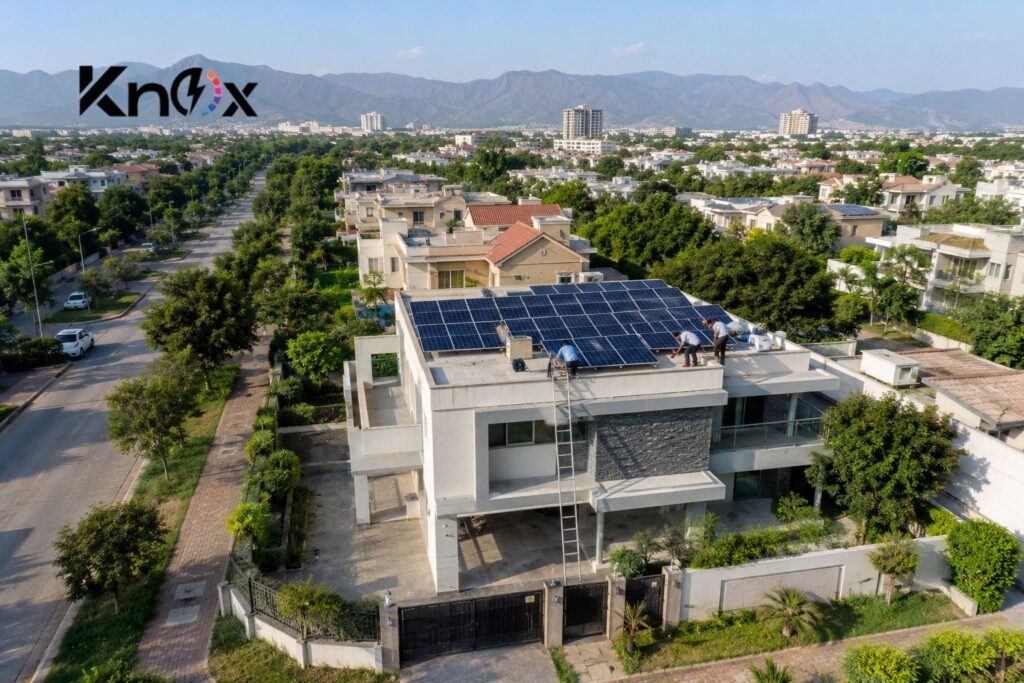
Imagine it in summer during peak temperatures. Suddenly, the fans are off because load shedding just hit again. You saw an electricity bill, and when you compare it with last year’s, somehow it’s increasing.
Suppose you’re facing this problem. Do not worry, because you are not alone.
Across Pakistan and even in major cities of Pakistan, this exact problem is pushing millions of households towards the same question: How do we take control of our own power
Solar setup is not just optional anymore. Now it has become a necessity for people. Because for daily usage and business sectors, we can not rely on unreliable grid supply.
Why you should choose the best Solar Setup
Choosing the right solar means choosing quality, reliability, and long-term efficiency without faults.
This guide walks you through everything. What a proper solar installation kit includes, what installation actually costs in 2026, when DIY makes sense, and the mistakes that trip up even well-meaning homeowners.
Why Getting the Installation Right Matters More Than You Think
Here’s something most guides skip over. A solar system isn’t just “panels on a roof.” It’s an interconnected electrical system where every component depends on the others working correctly.
Mismatched inverters, undersized wiring, or a poorly rated charge controller don’t just hurt performance. They can void your warranty, trigger fires, or leave you with a system that fails within its first year.
A properly matched solar installation kit removes that guesswork. Every component, from the panels to the inverter to the mounting hardware, is selected to work together instead of against each other.
This is exactly why so many first-time buyers end up disappointed. They shop for the cheapest panel or the biggest battery without asking whether the whole system was designed to function as one unit.
What’s Actually Inside a Solar Panel Installation Kit
A complete kit typically includes:
In 2026, dominance will be gained by solar panels, mainly by monocrystalline panels due to their superior efficiency.
- A grid-tie, off-grid, or hybrid inverter
- Mounting structure suited to your roof type
- DC and AC wiring harnesses
- MC4 connectors
- Circuit breakers and surge protection
- A charge controller (MPPT is the standard now)
- Battery storage for off-grid or hybrid systems
- A monitoring app for real-time visibility
Premium kits sometimes bundle a dedicated solar installer tool kit too, which we’ll get into shortly.
Grid-Tied, Off-Grid, or Hybrid: Which Solar Panel Setup Fits Your Life?
This is where a lot of people get stuck, and honestly, it’s the single most important decision in the entire process.
On-Grid Solar Systems
One type is called an on-grid solar system, which is connected to a grid-tie inverter and draws power from the utility grid. The excess electricity you produce is returned to the grid, and if you are on net metering, you receive credit for that electricity.
They come in at the lowest cost because they do not require batteries. The catch? Without power to the grid, there is no power to your system. It’s a safety precaution and not a defect: grid-tie inverters have to be connected to the grid to prevent feeding power back into the utility workers if the grid is down for maintenance.
Works best for residential properties with reliable electrical power and a net metering incentive.
Off-Grid Solar Systems
An off-grid solar system needs nothing from the utility. Panels feed a charge controller, which charges a battery bank, which powers an off-grid inverter.
These setups genuinely shine for farmhouses, remote agricultural pumping, or construction sites with no grid access at all. The tradeoff is a bigger battery bank to survive multiple cloudy days, which raises the upfront cost.
Hybrid Solar Systems
For most Pakistani households dealing with daily load shedding, a hybrid solar system is the real sweet spot. It stays connected to the grid, stores surplus solar in batteries, and switches to backup power automatically the second the grid drops, usually in under 20 milliseconds.
Your fridge, your fans, your workspace- none of it even notices the outage happened. If you’re weighing your options, it’s worth browsing Knox PV’s full range of solar solutions to see which configuration actually matches your consumption pattern rather than just picking the most popular size.
Choosing the Right Solar Components (Where Most People Go Wrong)
Let’s get specific, because this is the part that actually determines whether your system lasts 25 years or falls apart in five.
The Inverter Is the Brain, Treat It Like One
Cutting corners on the inverter is the single most common mistake in budget installations. A poor-quality unit fails within three to five years and can quietly void your entire system warranty in the process.
Spend time comparing inverter options the same way you’d compare a car engine. It’s the component doing the most work, every single day.
Mounting Structure: Boring but Critical
Nobody gets excited about aluminum rails and roof clamps, but this is genuinely how installations fail quietly over time. RCC roofs, metal sheet roofs, and tile roofs each need different mounting hardware.
Ask for the wind load rating on any mounting structure. For Pakistan’s coastal and northern regions, 200 km/h or above is the benchmark you want.
MC4 Connectors: Small Part, Big Risk
Counterfeit MC4 connectors are one of the leading causes of rooftop fires in solar systems. A loose or corroded connection generates heat, and that heat has to go somewhere.
Stick to genuine connectors from recognized manufacturers, and never mix connector brands within the same circuit.
MPPT Charge Controllers Earn Their Price
For any system above 1 kW, MPPT controllers extract 15 to 30 percent more usable energy than older PWM technology, especially during early morning and overcast conditions. The efficiency gain usually pays for the price gap in under a year.
Battery Storage Changes the Whole Equation
Lithium battery prices have dropped more than 80 percent over the past decade, which is a huge part of why storage finally makes financial sense for ordinary households. LiFePO4 batteries last three to five times longer than lead-acid and need essentially zero maintenance.
If backup power during outages matters to you, it’s worth comparing Knox PV’s residential energy storage and Powerwall series options before locking in a system size.
The Solar Installation Process, Explained Without the Jargon
Here’s what actually happens on installation day, step by step, so you know what to expect and what questions to ask.
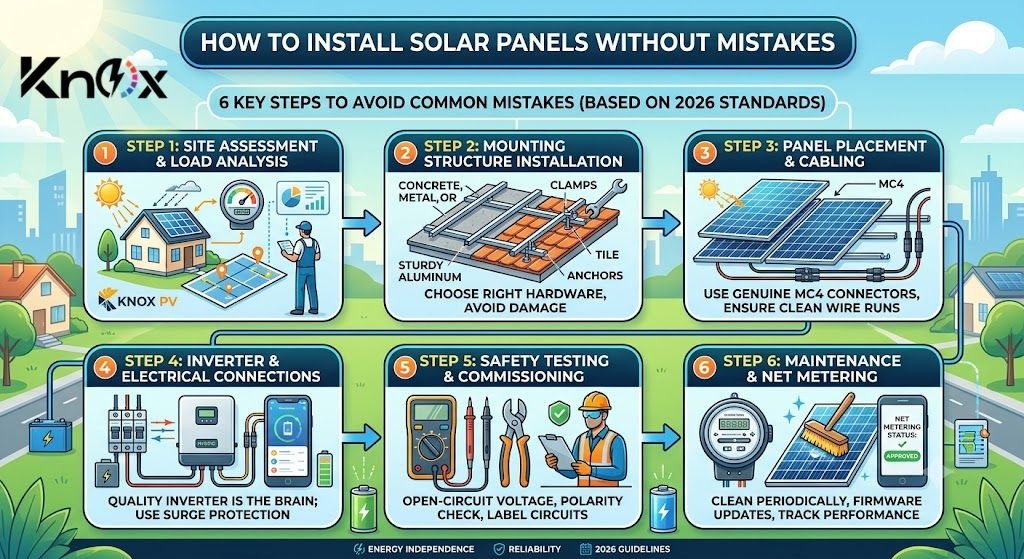
Step 1: Site assessment and load analysis. An installer assesses the details of roof orientation, pitch, shading, and structure and determines the size of a system based on your energy usage. Request a shading examination. It is the number one cause of systems not functioning properly.
Step 2: Mounting structure installation. Rails get anchored into rafters or concrete beams, not just roof cladding, and every penetration gets sealed against water ingress.
Step 3: Panel placement and cabling. Panels are secured with mid-clamps and end-clamps, then wired in series or parallel depending on your inverter’s specifications.
Step 4: Inverter and electrical connections. The inverter goes in a shaded, ventilated spot near your distribution board. Ask your installer to label every circuit clearly, since future troubleshooting depends on it.
Step 5: Safety testing and commissioning. Before anything gets energized, a proper installer runs open-circuit voltage tests, insulation resistance checks, and polarity verification.
Step 6: Net metering application. For grid-tied and hybrid systems, your installer submits the interconnection paperwork to your utility.
Self-Install Solar Panel Projects: When DIY Actually Makes Sense
A self-install solar panel approach genuinely works for small off-grid systems under 2 kW, like sheds, farms, or backup lighting setups, especially if you already have some DC electrical experience.
Where DIY installation stops making sense:
- Any grid-tied or net metering system (utilities require certified installation)
- Rooftop systems needing structural assessment
- Hybrid systems with lithium battery banks
- Anything above 5 kW, which most safety codes classify as licensed work
A smart middle ground many homeowners choose is buying their own solar installation kit and hiring a certified installer just for the electrical work. You save on markup while still getting compliant, warranty-safe installation.
Common Solar Installation Mistakes That Cost People Money
After seeing enough installations go sideways, a pattern emerges. The same handful of mistakes keep showing up:
- Undersizing the system to save money upfront, then regretting it within a year
- Choosing the cheapest inverter without checking its actual efficiency rating
- Skipping battery storage in areas with heavy load shedding
- Never verifying the installer’s certifications or past project references
- Skipping a proper shading analysis before panels go up
- Accepting quotes that sit 30 to 40 percent below market rate, which almost always reflects the component quality
If a proposal arrives without a site visit or load calculation, treat that as a warning sign, not a shortcut.
The Solar Installer Tool Kit: Why Proper Tools Actually Matter
Professional installation requires tools beyond a standard electrician’s kit. This isn’t about gear for its own sake; it’s about doing the job safely without voiding equipment warranties.
Essential tools include an MC4 crimping tool, a clamp meter and multimeter for polarity checks, a torque wrench for mounting bolts, insulated screwdrivers rated for DC voltage, and a thermal camera for post-installation hotspot detection.
If a contractor shows up without MC4 crimping tools, that’s worth asking questions about before work begins.
Solar Installation Cost in 2026: What You’ll Actually Pay
Solar installation cost varies a fair amount depending on system type and capacity, but here’s a realistic breakdown for the Pakistani market: Several factors push these numbers up or down: panel brand and efficiency, inverter quality, battery chemistry, roof complexity, and net metering.
A well-designed 5 kW hybrid system consuming around 700 units monthly can cut a typical Rs. 25,000 bill by 70 to 80 percent, with payback in roughly three to four years and two decades of essentially free electricity after that.
Net Metering in Pakistan: How It Actually Works
Under NEPRA’s net metering regulations, homeowners with grid-tied or hybrid systems can export surplus solar power during sunny hours and import from the grid at night, settling the difference on a monthly bill.
Approval requires a certified installer and specific inverter certifications, and the process typically takes 30 to 60 days from application to bi-directional meter installation.
For many households, a correctly sized system achieves near-zero net consumption for most of the year, which is a genuinely different financial position than just “a lower bill.”
What Happens After Installation: Maintenance That Actually Keeps Your System Performing
Solar systems are low-maintenance, not zero-maintenance, and the difference matters.
- Clean panels every 1 to 3 months. Dust accumulation alone can cut output by 20 to 25 percent in dry regions like Pakistan
- Keep inverter firmware updated annually through the monitoring app
- Schedule a professional inspection every 2 to 3 years
- Watch your monitoring app for unusual drops in generation, which often signal a developing fault before it becomes a costly one
Most quality inverters in 2026 include built-in Wi-Fi monitoring, giving you real-time visibility into generation, battery health, and grid export straight from your phone.
Solar Safety: A Few Things Worth Repeating
Solar strings carry 300 to 600V DC even when the inverter is switched off, which deserves real respect.
Never work on live panels, always verify polarity before connecting anything, use insulated tools rated for DC voltage, and never work alone on a rooftop. If you’re ever unsure, a professional inspection is a trivial cost compared to what can go wrong without one.
Making the Decision: Your Next Step Toward Energy Independence
Solar in 2026 isn’t a gamble anymore. It’s a calculated financial decision backed by mature technology, strong warranties, and a clear path to eliminating your dependence on an unpredictable grid.
Whether you’re dealing with daily load shedding, running a business that can’t afford downtime, or building somewhere off-grid entirely, there’s a configuration built for your exact situation.
Before anything else, get a proper site assessment, review your last twelve months of electricity bills for seasonal patterns, and compare at least three detailed proposals before committing to anyone.
If you’re ready to explore which system actually fits your home or business, take a look at Knox PV’s full lineup of solar products, or reach out through the contact page to talk through your specific site and consumption needs. You can also browse theFAQs or read more on theKnox PV blog for deeper dives into inverters, batteries, and system sizing.
The sun isn’t going anywhere. Neither should your savings.