


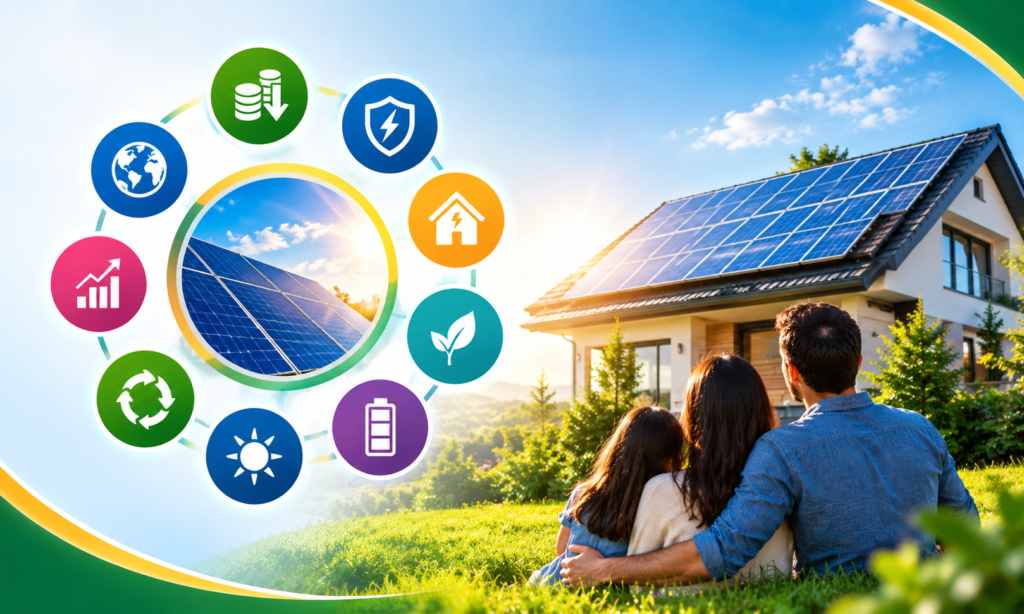
12 Powerful Advantages of Solar Energy in 2026
Your electricity bill arrives. You wince. Again.
Maybe you’ve watched it climb steadily for the past few years. Maybe you’re in a country where load shedding has made reliable power feel like a luxury. Or perhaps you’re a business owner watching energy costs eat deeper into your margins every quarter and there’s no sign of relief from the grid.
You’re not alone. Electricity prices have risen sharply across most of the world, and the traditional power grid built on fossil fuels, aging infrastructure, and centralized control simply wasn’t designed for today’s demands.
That’s exactly why millions of homeowners and businesses are turning to solar. Not as an act of idealism, but as one of the most practical financial decisions they’ve ever made. The advantages of solar energy go far beyond “helping the planet” they touch your wallet, your property, your independence, and your peace of mind.
Here’s everything you need to know.
What Is Solar Energy?
Sunlight that’s been transformed into electricity is solar power. Photovoltaic (PV) cells are used in solar panels to generate direct current (DC) electricity when they are exposed to sunlight. That is then converted by an inverter into alternating current (AC) which is the current type used in your home or business.
A complete solar system consists of:
- Solar panels mounted on your roof or on ground-level frames
- An inverter to convert DC to usable AC power
- Optional battery storage to save power for evenings or outages
- A monitoring system to track your energy production in real time
It can be used in homes, business, farm, school, factory and anywhere in between. They are made up of a few panels to provide a small house with power, or a large commercial array for an entire campus.
Why Solar Energy Matters More Than Ever in 2025
The case for solar has never been stronger and that’s not marketing language. Here’s what’s actually happening:
- Electricity prices have risen 20–40% in many countries over the past five years, with no stabilization in sight
- Grid reliability is declining in multiple regions due to aging infrastructure and increased demand from EV adoption and heat pumps
- Load shedding remains a daily reality for millions across Africa, South Asia, and parts of South America
- Solar panel costs have dropped more than 90% over the past decade, making the technology more accessible than ever before
- Climate pressure is pushing governments to incentivize clean energy adoption through subsidies, tax credits, and net metering programs
The combination of falling costs and rising electricity prices has created a window that simply didn’t exist 10 years ago. In many regions, going solar now pays for itself faster than it ever has.
Top 12 Advantages of Solar Energy
1. Lower Electricity Bills — Starting Immediately
This is the one most people feel first. A properly sized solar system can cover 70–100% of a household’s electricity needs. That means your monthly bill drops dramatically often to near zero for daytime power users.
Most homeowners find the reduction noticeable from their very first bill after installation. Over the course of a year, those savings add up fast.
2. Protection from Rising Energy Prices
When you generate your own power, you’re shielded from utility price hikes. Grid electricity prices will almost certainly keep rising fuel costs, transmission upgrades, and energy demand guarantees it. Solar locks in a stable, predictable cost of power for 25+ years.
Think of it less like buying a product and more like buying decades of energy at today’s price.
3. Backup Power During Outages and Load Shedding
One of the most underappreciated benefits of solar energy especially for households in countries with unreliable grids is backup capability.
Pair your solar system with battery storage (like a lithium battery bank), and you have a hybrid system that keeps your lights on, your fridge running, and your business operating when the grid goes down. No generator noise. No fuel costs. No dependency on a grid that keeps letting you down.
Many businesses now rely on solar-plus-battery setups as their primary energy resilience strategy.
4. Renewable and Essentially Unlimited
The sun has approximately 5 billion years of fuel left. That’s a supply chain problem you never have to worry about.
Unlike coal, gas, or oil all of which are finite, politically volatile, and increasingly expensive to extract sunlight is free, local, and inexhaustible. Every kilowatt-hour your panels produce is one less unit pulled from a resource that’s running out.
5. Zero Emissions, Cleaner Air
Solar panels produce electricity with no combustion, no exhaust, and no greenhouse gas emissions during operation. The manufacturing process has a carbon footprint, but modern solar panels offset that within 1–4 years of operation and then run cleanly for 25+ years after.
For families concerned about air quality, climate change, or simply leaving a livable planet for their children, the environmental advantages of solar energy are real and measurable.
6. Strong Return on Investment
Solar isn’t an expense it’s an investment with a calculable return. In many regions, residential solar systems pay back their installation cost within 5–9 years. After that, the energy they produce is essentially free for the remaining 15–20+ years of the system’s life.
Factor in rising electricity prices which make your solar savings grow each year and the ROI becomes even more compelling. A quality solar installation is one of the few home improvements with a near-guaranteed financial return.
7. Low Maintenance, Low Stress
Modern solar panels have no moving parts. They don’t wear out like engines or motors. Most manufacturers offer 25-year performance warranties, and many panels continue producing well beyond that.
Day-to-day maintenance is minimal: an occasional cleaning, a check of the inverter display, and an annual professional inspection. There’s no fuel to source, no filters to replace, no regular servicing schedule. Once installed, a solar system largely takes care of itself.
8. Increases Property Value
Multiple real estate studies have found that solar installations increase home resale values often by more than the cost of installation. Buyers are increasingly willing to pay a premium for a home with low or no electricity bills already built in.
In competitive property markets, solar is becoming a genuine selling point rather than a novelty.
9. Energy Independence
There’s a psychological dimension to solar that’s easy to underestimate: the feeling of not being at the mercy of a utility company or a volatile global fuel market.
When you generate your own power, rate hikes become someone else’s problem. Rolling blackouts become an inconvenience you watch from the outside. For families and businesses in regions with unreliable supply, this kind of energy independence is genuinely life-changing.
10. Job Creation and Economic Growth
The solar industry is one of the fastest-growing employment sectors globally. Installation, manufacturing, maintenance, engineering, and sales have all created millions of jobs over the past decade and that growth is accelerating.
When a community adopts solar at scale, much of the investment stays local: local installers, local electricians, local businesses. That’s an economic multiplier effect that fossil fuel imports simply can’t match.
11. Works for Homes, Businesses, and Everything Between
Solar energy isn’t one-size-fits-all it scales beautifully.
- Homes: Rooftop panels cover most or all household electricity use
- Businesses and offices: Reduces operating costs and improves sustainability credentials
- Farms: Powers irrigation pumps, cold storage, and processing equipment
- Schools and hospitals: Provides reliable power in areas with grid instability
- EV charging: Solar-powered charging stations for electric vehicles are increasingly common
- Street lighting and remote infrastructure: Off-grid solar powers communities where grid connection is impractical
12. Government Incentives and Net Metering
In many countries and regions, going solar comes with meaningful financial support:
- Tax credits that reduce your installation cost by 20–30% or more
- Net metering programs that pay you for excess electricity you feed back into the grid
- Subsidies and rebates from municipal or national energy programs
- Accelerated depreciation for business solar installations
These incentives vary widely by location, but they can dramatically shorten your payback period. It’s worth researching what’s available in your region — or asking a local installer for a breakdown.
Real-World Savings Scenario
Here’s what the numbers might look like for a typical household:
Solar Energy in Everyday Life
The benefits of solar energy extend well beyond the monthly bill. Here’s where solar is already making a practical difference:
- Homes: Powering lighting, appliances, air conditioning, and water heating
- Offices: Cutting commercial electricity costs and meeting sustainability targets
- Factories: Offsetting heavy energy loads during daytime production hours
- Farms: Running irrigation pumps and cold storage without fuel costs
- Water heating: Solar thermal systems for residential and commercial hot water
- EV charging: Home and fleet charging powered by clean, free sunlight
- Remote areas: Off-grid solar delivering power to communities beyond the grid’s reach
Common Myths About Solar — Debunked
“Solar doesn’t work on cloudy days.” False. Solar panels produce electricity from daylight, not direct sunlight. Output is reduced on overcast days, but not eliminated. Germany — one of the cloudiest countries in Europe — is also one of the world’s leading solar markets.
“Solar is too expensive.” This was true a decade ago. Today, solar panel costs have dropped more than 90% since 2010. In most markets, the lifetime savings dramatically exceed the upfront cost. And with financing options widely available, many homeowners install solar with little or no money down.
“Solar needs constant maintenance.” Modern solar systems are remarkably low-maintenance. An occasional rinse and annual check covers most systems for their entire lifespan.
“Solar only works well in summer.” Solar produces power year-round. Winter days are shorter, so output is lower — but a properly designed system accounts for seasonal variation. Many regions actually see excellent solar production in winter due to clear, cold skies and snow reflection.
Is Solar Worth It in 2025?
Short answer: for most homeowners and businesses, yes — and often by a significant margin.
The case is strongest where electricity bills are high, sunlight is strong, and government incentives are available. But even in less sunny regions and without major subsidies, the falling cost of solar technology and the continued rise of grid electricity prices make the math work in most scenarios.
The one real variable is how long you plan to stay in your home or business location. Solar’s returns accumulate over time. If you’re staying put for 7+ years, the investment almost always makes sense.
If you’re unsure, the smartest first step is a no-obligation savings estimate from a qualified local installer. The numbers will tell the story clearly.
Frequently Asked Questions
How long does solar take to pay for itself?
Most residential systems reach payback within 5–9 years, depending on your electricity rates, available incentives, and system size. After payback, the energy is essentially free.
Can solar power run an air conditioner?
Yes. Air conditioning is one of the most common applications for solar. A properly sized system can run AC comfortably during daylight hours, and battery storage extends that into evenings.
Does solar work during load shedding?
A standard grid-tied solar system without batteries shuts down during outages for safety reasons. However, a hybrid or off-grid solar system with battery backup continues to supply power throughout load shedding. This is one of the primary reasons homeowners in affected regions choose solar.
What maintenance does a solar system need?
Very little. Panel cleaning every few months, a periodic inverter check, and an annual professional inspection covers most systems. There’s no fuel, no engine oil, no filters.
How long do solar panels last? Most quality panels carry 25-year performance warranties and continue producing power well beyond that often 30–35 years. Output degrades slightly over time (typically 0.5% per year), but performance remains strong for decades.
Is solar expensive to install?
Upfront costs vary by system size and location, but the industry has become much more competitive. Many installers offer financing, lease, or power purchase agreement (PPA) options that let homeowners go solar with little or no upfront cost.
Do I need batteries?
Not necessarily. Grid-tied solar without batteries is the most affordable option and works well in areas with stable grid power and net metering. Batteries add cost but provide backup power and greater energy independence worth it if outages are a concern.
Can businesses benefit from solar the same way homes do?
Yes — often even more so. Businesses typically have high daytime energy use that aligns well with solar production. Commercial installations also qualify for accelerated depreciation and tax incentives in many jurisdictions, improving the financial case further.
Conclusion
The advantages of solar energy aren’t theoretical they show up in lower bills, greater resilience, and real financial returns that compound over years and decades.
We’re living through a genuine energy transition, and the households and businesses that act now will benefit most: lower costs locked in before prices rise further, systems paid back while incentives are still available, and independence from a grid that’s becoming less reliable, not more.
The first step is simply understanding what solar could mean for your specific situation. Get a savings estimate. Talk to a local installer. Run the numbers for your home or business.
Most people who do are surprised by how compelling the case already is.