


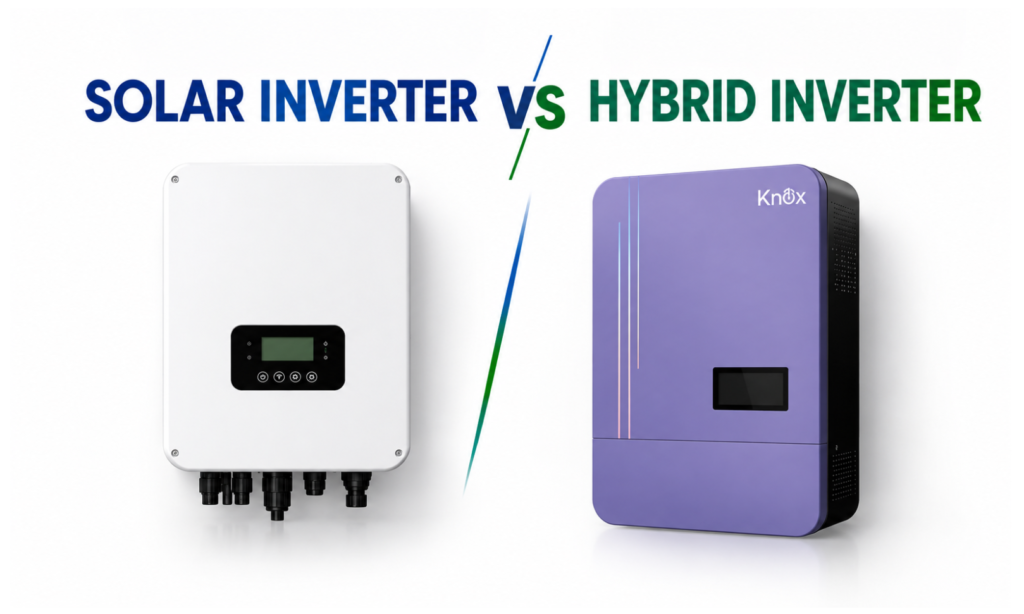
Solar Inverter vs Hybrid Inverter Which One Is Right for You?
Choosing an inverter is one of the most important decisions in any solar project. The inverter is the “brain” of your system. It turns the DC power from your panels into AC power that your lights, appliances and equipment can use. But not every inverter does the same job.
The main difference is simple. A standard solar inverter converts and delivers solar power. A hybrid inverter does that too, and it also manages a battery and the grid. This guide explains both so homeowners, installers and business owners anywhere in the world can choose the right one. You can also browse the full KNOX Solar range as you read.
What Is a Solar Inverter?
A solar inverter (also called a PV or grid-tied inverter) converts the direct current (DC) from your panels into alternating current (AC). Your home or business uses that power immediately. Any surplus can be exported to the grid, subject to your local utility rules.
Grid-tied inverters are popular because they are simple, efficient and affordable. Commercial and industrial sites often rely on them at larger scale, such as the C&I on-grid inverters from KNOX.
Key Features of a Solar Inverter
- Converts solar DC power into usable AC electricity
- Maximises energy harvest from the panels
- Supplies household or commercial loads directly
- Can export excess power to the grid
- Works without batteries
- Suits standard grid-connected systems
An important limitation: most grid-tied inverters shut down automatically during a blackout. This safety feature is called anti-islanding. It protects utility workers from live current on the line. So even on a sunny day, a standard solar inverter will not keep your lights on in an outage unless extra backup equipment is installed. Many people don’t know this until the first blackout.
What Is a Hybrid Inverter?
A hybrid inverter combines a solar inverter and a battery inverter/charger in one unit. It manages four things together: your solar panels, your battery, your household loads and the grid.
During the day, solar power runs your appliances and charges the battery with any surplus. When the sun goes down, the battery supplies your home. If the grid fails, a properly configured hybrid system can keep essential loads running.
Key Features of a Hybrid Inverter
- Supports solar panels and battery storage together
- Stores surplus solar energy instead of exporting it
- Reduces how much electricity you buy from the grid
- Can provide backup power during outages
- Offers smart control over when to charge, discharge or import
- Increases solar self-consumption
- Makes later battery upgrades easier
KNOX pairs this approach with its residential energy storage range, built for homes that want savings and independence in one system.
Solar Inverter vs Hybrid Inverter Key Differences
Feature | Solar Inverter | Hybrid Inverter |
Solar panel connection | Yes | Yes |
Converts DC to AC | Yes | Yes |
Battery support | Usually no | Yes |
Energy storage management | Limited | Yes |
Grid connection | Yes | Yes |
Backup power | Usually no | Often available |
Energy management | Basic | Advanced |
System complexity | Lower | Higher |
Upfront cost | Lower | Higher |
Flexibility | Standard | High |
If your goal is simply to generate solar power and cut your bill, a solar inverter is usually enough. If you want storage, backup or smarter energy control, a hybrid inverter fits better.
How Do They Work?
Solar inverter: Panels → Inverter → Home loads → Grid (surplus)
Hybrid inverter: Panels → Hybrid inverter → Home loads / Battery / Grid
A hybrid inverter decides where each unit of energy goes. It looks at your settings, current demand, battery charge level, solar output and grid conditions. On a sunny afternoon, it may power your appliances and fill the battery. In the evening, it draws from the battery instead of the grid.
Which Is More Efficient?
Both types can reach high conversion efficiency, so the better question is how efficient the whole system is.
A solar inverter converts power once and uses it straight away, which is very efficient. A hybrid system loses a small amount of energy each time power is stored in a battery and released later. However, storing midday surplus lets you use solar energy that would otherwise be exported at a low rate, or wasted where export is limited.
So the answer depends on your usage:
- Mostly daytime use (offices, shops, factories): a solar inverter is often enough.
- Mostly evening or night use (families, homes with air conditioning or heating): a hybrid inverter usually delivers more real-world value.
Which One Is Better for You?
- You want a simple, grid-connected system
- Most of your power use happens in daylight
- You don’t need batteries right now
- Your priority is lower bills at the lowest upfront cost
- Your grid is stable and export is rewarded
Choose a Hybrid Inverter If
- You want solar and batteries together
- You use a lot of electricity at night
- Power cuts or load-shedding affect you
- Your utility pays little for exported power
- You want more energy independence
- You plan to add storage later
Can a Hybrid Inverter Work Without a Battery?
Yes. Many hybrid inverters run with solar and the grid only, and you can add a battery later. Compatibility varies by model, so check the battery chemistry, voltage range, capacity limits, communication protocol and backup rating before you buy.
KNOX offers wall-mounted Powerwall IP20 units for indoor installation and Powerwall IP54 units for environments that need better protection against dust and moisture. Choosing a compatible inverter now saves you from replacing equipment later.
What Should You Consider Before Buying?
Look beyond the price tag.
- System size: Match the inverter’s power rating to your array and your real demand.
- Battery needs: Confirm compatibility and charging specifications.
- Backup power: Check which loads the inverter can supply in an outage, and for how long.
- Whole-system efficiency: A high rated efficiency matters less than good overall design.
- Monitoring: Look for an app that shows production, battery status and grid use in real time.
- Local rules: Net metering, export limits and grid-connection standards differ by country and utility.
- Warranty and support: Choose a brand with clear certification, strong after-sales help and available spare parts.
Our About Us page explains how KNOX approaches quality and long-term support. Our FAQs cover many common buying questions.