


How to Protect Your Solar Inverter from Heat and Dust in Pakistan
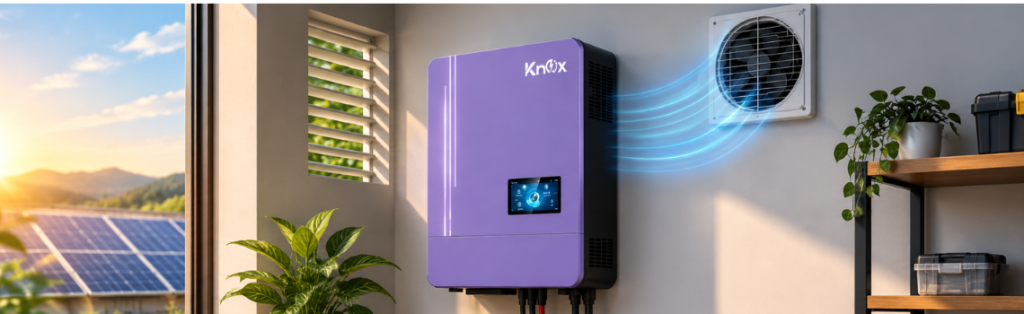
Put the inverter in an indoor location that is shaded, well ventilated and has 30-50 cm of space around all sides. Do not cover it, clean casing every month and clean vents monthly with compressed air.
Your panels may receive attention, but it’s the inverter that does the heavy lifting. It helps you transform direct-current (DC) power into alternating-current (AC) power that you can use, which means that you’ll also be safeguarding your total investment.
With summer temperatures above 45°C, dust-heavy winds and unstable grid voltage, Pakistan is one of the harshest places for this equipment.
A quality Knox solar inverter performs best when installed and maintained correctly.
Why Heat Is the Inverter’s Biggest Enemy
Thermal Derating Explained
All modern inverters have some level of protection that decreases output when internal temperature exceeds a certain level. This protective feature is called thermal derating. On a hot day, a 10 kW rating might be significantly less on demand just when your air conditioning units require it the most. This is because the bills will be more expensive on their grid and they’ll have a lower payback.
Capacitor Ageing
Sustained heat slowly dries out electrolytic capacitors. Once they degrade, you may see random error codes, unstable output or complete failure. Keeping the unit cool is the best way to extend its life.
How Dust Damages Inverters
Dust may seem harmless, but it causes several problems:
- Insulates components, trapping heat on heatsinks and circuit boards
- Clogs vents and filters, reducing airflow
- Wears fan bearings, leading to noise, fan faults and shutdowns
- Mixes with humidity, forming a conductive or corrosive film, especially in coastal Karachi
Choosing the Right Mounting Location
Best Option: Indoor, Shaded and Ventilated
A garage, utility room or covered service area keeps the casing far cooler than an exposed wall.
If You Must Install Outdoors
- Choose a north-facing wall away from direct sun
- Add a ventilated shade hood (never a sealed box)
- Keep it off rooftops and west-facing walls
The IP65 Myth
IP65 rating indicates that the enclosure is dust and water resistant. It does not mean anything to survive direct sun. A well capped sunlit casing will overheat.
Clearance Rules
- Leave 30 to 50 cm around the unit, or follow your manual if it specifies more
- Avoid tight cupboards, ceiling corners and cluttered storerooms
- Never place items on or beside the vents
Cooling Solutions That Actually Help
- Exhaust fan near the ceiling to remove hot air from small rooms
- Filtered intake vents to keep dust out
- Wall fan directed across the heatsink on very hot days
- Air-conditioned control room for large residential or commercial systems
Never wrap the inverter in cloth, plastic or cardboard. It traps heat and creates a fire risk.
Defend Against Grid Voltage Problems
Unstable supply from WAPDA or K-Electric adds electrical stress and extra heat. A proper protection box should include:
- Type 2 surge protective devices (SPDs)
- Correctly rated breakers
- An over/under-voltage protection relay
Have a certified installer size and wire these components. Explore complete solar system solutions designed for local grid conditions.
Practical Maintenance Schedule
Frequency | Task |
Monthly | Visual check, dry microfiber wipe, inspect vents and any removable filter |
Every 3 to 6 months | Safe shutdown, then compressed-air cleaning of fins and fan openings |
Twice a year | Listen for fan grinding, check clearance, look for error history |
Yearly | Professional inspection of terminals, cabling and earthing |
Safe Shutdown Order
- Turn off the AC breaker
- Switch off the DC isolator
- Wait several minutes before cleaning
- Use only dry tools, never water or liquid cleaners
Warning Signs Your Inverter Is Overheating
- Output drops sharply during midday
- Frequent temperature or fan error codes
- Casing too hot to touch comfortably
- Unusual fan noise or a burning smell (switch off and call a technician)
Protect Your Warranty
Manufacturers may reject claims if damage points to poor installation, blocked vents or dust neglect. Always:
- Hire certified installers
- Keep clearance and ventilation as specified
- Record maintenance dates
- Never attempt DC wiring or earthing yourself.
Browse Knox solar products and speak with professionals before installation.