


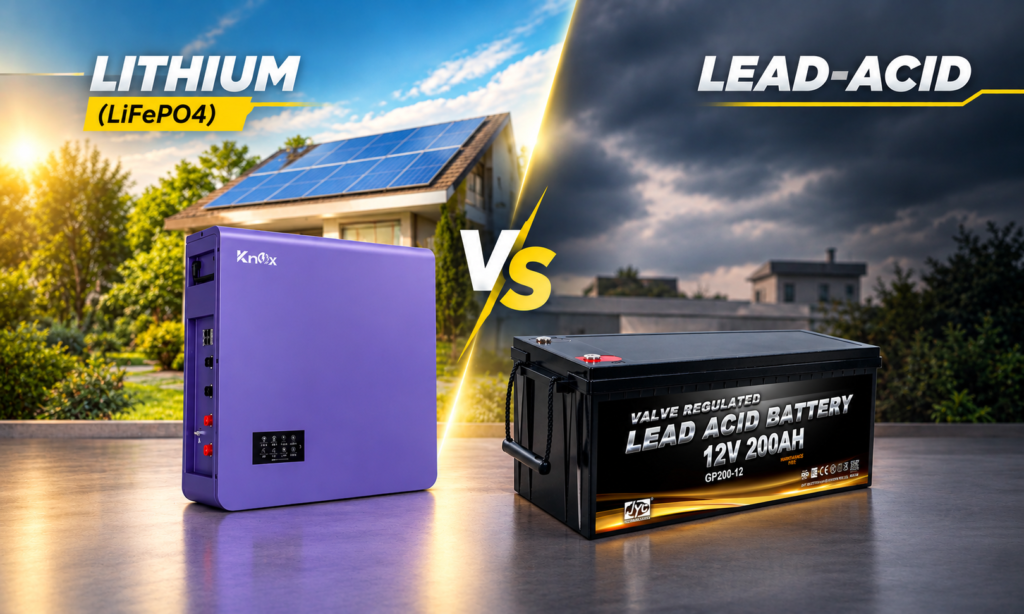
Lithium vs Lead-Acid Batteries: Which Is Better for Solar Systems?
When you’re designing a solar power system for your home or business in Pakistan, a battery is as important as the panels on the roof. It determines the capacity of the power that you can use, duration of the investment and the amount of investment that you will have to invest in fixing or replacing the investment down the road. At Knox Solar, this is one of the most common questions our customers ask us and the short answer is lithium (LiFePO4) is the better long-term choice for most solar setups, though lead-acid still has a place in specific budget scenarios.
Here’s a full, honest breakdown.
Lead-Acid vs. Lithium The Basics
Flooded Lead-Acid (FLA)
FLA batteries are not good in qulaity and also very difficult for people to maintain because when they realease a gas then it has to need a proper ventilation. Skipping maintenance shortens their life dramatically a real problem in Pakistan’s dusty, high-heat rooftop environments.
Sealed Lead-Acid (SLA / Tubular)
Sealed and tubular variants need no water refills and are spill-proof, but they still carry the core weaknesses of lead-acid chemistry: limited depth of discharge and a shorter overall lifespan.
Lithium Iron Phosphate (LiFePO4)
LiFePO4 is the safest and most thermally stable lithium chemistry available, which is exactly why it’s the standard chemistry behind every Knox lithium battery solution. It tolerates Pakistan’s extreme summer heat far better than lead-acid or other lithium chemistries like NMC, without the risk of thermal runaway.
Head-to-Head Comparison
Factor | Lead-Acid (FLA/SLA) | Lithium (LiFePO4) |
Typical cycle life | 300–500 cycles | 3,000–8,000+ cycles |
Usable depth of discharge | ~50% | 80–100% |
Round-trip efficiency | 75–85% | 95–98% |
Charging speed | 6–8 hours | 1–2 hours |
Maintenance | Regular water top-ups (FLA) | None |
Weight for same capacity | Heavier | 40–60% lighter |
Real-world lifespan (daily cycling) | 1.5–3 years | 8–16+ years |
Upfront cost | Lower | Higher |
10-year total cost of ownership | Often higher (repeat replacements) | Often lower |
Why Lithium Wins for Pakistani Solar Systems
Longer cycle life
Where a lead-acid battery may need replacing two or three times over a decade of daily loadshedding-driven cycling, a quality LiFePO4 pack from a Knox solar system is built to handle that same daily use for well over a decade.
Deeper usable capacity
The life of lead-acid batteries should be kept at a minimum of 50% charge to preserve its life, which means the 200Ah battery provides 100Ah of usable capacity. You can also reduce the amount of Lithium used down to 80-100% and get the same usable capacity.
Higher efficiency
Lead-acid batteries lose 15–25% of the solar energy sent into them during charging and discharging. Lithium loses only 2–5%, so more of the electricity your solar panels generate actually reaches your appliances.
Faster recharge
Lithium accepts a much higher charge current, refilling in a fraction of the time lead-acid needs useful on cloudy days when charging windows are short.
Thermal safety in heat
With rooftop and utility-room temperatures in Punjab and Sindh regularly crossing 45°C in summer, LiFePO4’s stability is a genuine safety advantage over other battery chemistries.
Zero maintenance
No distilled water, no terminal cleaning, no ventilation requirements.
But run the numbers over a decade: a lead-acid bank cycling daily under loadshedding conditions is usually replaced three to four times, plus the ongoing cost of maintenance and the electricity lost to lower efficiency. A single lithium pack, installed once through a Knox hybrid solar system, can outlast that entire replacement cycle while recovering more of your solar energy every single day often narrowing or even reversing the total cost gap by year eight or nine.
Which Battery Should You Actually Choose?
- Full-time home or business use with daily cycling → Lithium. The cycle life and efficiency gains pay for themselves.
- Vacation home or occasional backup → Sealed lead-acid can still make sense, since the battery won’t see heavy daily use.
- Budget-constrained first-time solar buyers → Lead-acid can be a reasonable entry point, with an upgrade path to lithium later.
- Serious, long-term energy independence → Lithium is the clear winner, and it’s the chemistry we recommend across our Knox lithium battery range.
Conclusion
Lithium (LiFePO4) is the preferred battery for solar systems because it outperforms most types of batteries that are used by households and businesses in Pakistan who suffer from loadshedding and high ambient temperatures, and is a more cost effective and reliable option over the life of the system. If you’re unsure which capacity or configuration fits your home, get in touch with the Knox Solar team for a system recommendation built around your actual daily usage.