


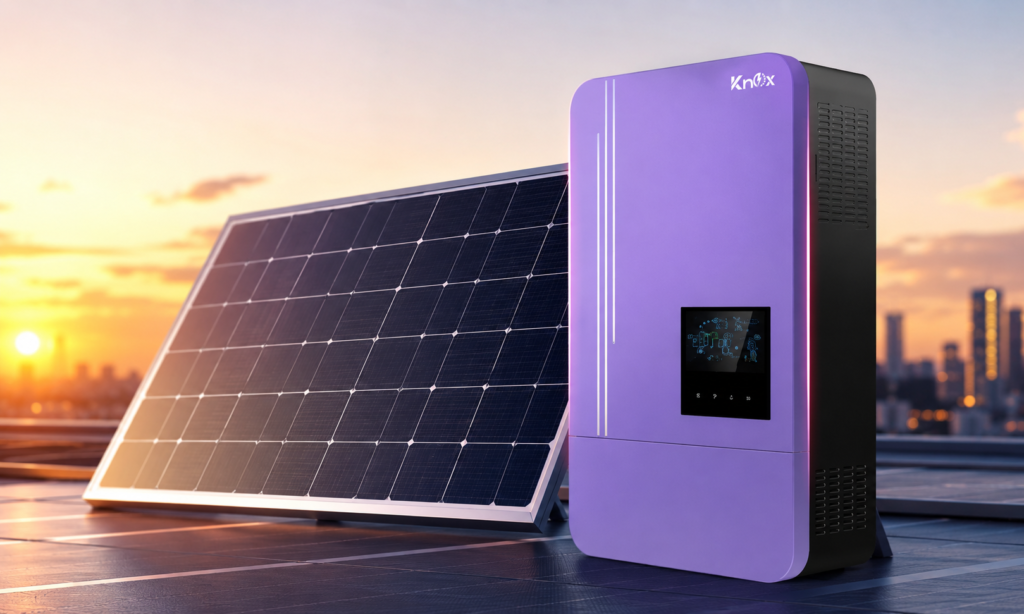
How Solar Inverter Works With Batteries a Complete Guide
If you’ve ever wondered what actually happens between the moment sunlight hits your rooftop panels and the moment your lights turn on at night, the answer lies in one piece of equipment: the solar inverter. It’s the quiet workhorse that connects your solar panels, your battery, and your home’s electrical system into one working unit.
Most people know what panels are (make electricity) and batteries are (store electricity), but it’s what happens in the inverter in between that is the magic and the engineering. Let’s dive into the details of how solar inverters connect with batteries, its importance for energy independence, and what to consider when selecting a solar inverter for your home or business. .
What Does a Solar Inverter Actually Do?
Solar panels generate direct current (DC) electricity. But the appliances in your home your fridge, your lights, your air conditioner run on alternating current (AC). The inverter’s core job is to convert that DC power into usable AC power.
But a modern solar inverter does far more than simple conversion. It also:
- Manages the flow of energy between panels, batteries, and the grid
- Protects your battery from overcharging or deep discharge
- Optimizes power output based on sunlight conditions (a process called MPPT, or Maximum Power Point Tracking)
- Switches automatically between solar, battery, and grid power depending on availability
This is why choosing the right inverter is just as important as choosing the right panels. A well-designed inverter system determines how efficiently your entire solar setup performs over its lifetime.
The Relationship Between Solar Inverters and Batteries
Now the fun begins. Some inverters are only designed to pump excess solar electricity directly into the grid, whereas other models are compatible with batteries. For storing energy for later use, you will need what is known as a hybrid inverter, which connects you solar array, your battery bank and your home power supply.
Step-by-Step: How the Process Works
- Sunlight hits the panels. Solar cells convert sunlight into DC electricity.
- The inverter receives the DC power. It decides, in real time, where that energy should go to your home, to the battery, or both.
- Excess power charges the battery. If your panels are producing more power than your home needs, the inverter redirects the surplus into your energy storage system instead of letting it go to waste.
- The battery stores DC energy. Batteries, like panels, store and release power in DC form, so no conversion happens at this stage.
- When needed, the inverter pulls power back out. At night or during a power outage, the inverter draws stored DC energy from the battery and converts it back into AC electricity for household use.
- The cycle repeats daily. This charge-and-discharge loop, managed entirely by the inverter, is what allows a home to run on stored solar energy around the clock.
This constant back-and-forth conversion is why the inverter is often called the “brain” of a solar-plus-battery system it’s making decisions every second about the most efficient use of available power.
Why Battery Integration Matters
Without a battery, solar power is only useful while the sun is shining. The moment clouds roll in or the sun sets, your home falls back on grid electricity. Pairing your system with a battery changes that equation entirely.
Key benefits of solar-battery integration:
- Energy independence – Store daytime solar power and use it after dark, reducing reliance on the grid
- Backup power during outages – A properly configured hybrid inverter can switch to battery power automatically when the grid goes down
- Lower electricity bills – Use stored solar energy during peak pricing hours instead of buying expensive grid power
- Reduced strain on the grid – Store and use your own energy rather than pulling from shared infrastructure at peak times
This is exactly why product lines like the Powerwall Series are built specifically to work in tandem with hybrid inverters the two components are designed to communicate and share load data continuously.
Types of Solar Inverters Used With Batteries
Not every inverter handles battery integration the same way. Understanding the differences helps you choose a system that matches your goals.
- Hybrid Inverters – Combine solar charging, battery management, and grid interaction in a single unit. Ideal for most residential setups.
- Battery-Based (Off-Grid) Inverters – Used in systems with no grid connection at all, relying entirely on solar and battery power.
- Grid-Tied Inverters With Battery Backup – Standard grid-tied inverters paired with a separate battery interface, often used in retrofitted systems.
For commercial and industrial applications, larger setups may rely on dedicated C&I on-grid inverter systems designed to handle higher loads while still integrating battery storage for backup and peak-shaving purposes.
How MPPT Technology Improves Battery Charging
One of the most important and least understood features of a modern inverter is MPPT (Maximum Power Point Tracking). Sunlight intensity changes constantly throughout the day due to clouds, shading, and the sun’s angle. MPPT technology continuously adjusts the electrical operating point of the panels to extract the maximum possible power at any given moment.
For battery charging specifically, this means:
- Batteries charge faster and more consistently, even in partial sunlight
- Less energy is wasted during low-light conditions
- The battery receives a stable, well-regulated charge that extends its lifespan
This is one of the reasons advanced systems from brands like Knox Solar emphasize smart, adaptive inverter technology it directly affects how much usable energy your battery actually stores each day.
Common Questions About Solar Inverters and Batteries
Do I need a special inverter for batteries? Yes. Standard grid-tied inverters typically cannot manage battery charging and discharging on their own. You’ll need a hybrid inverter or an off-grid inverter paired with a compatible battery management system.
Can I add a battery to an existing solar system later? In many cases, yes — but it depends on your current inverter. Some systems are “battery-ready,” meaning they already support storage integration, while older grid-tied-only inverters may need to be replaced or supplemented with a separate battery inverter.
How long do solar batteries last on a full charge? This depends on battery capacity, household energy usage, and how efficiently the inverter manages the discharge cycle. A well-matched inverter and battery pairing typically maximizes usable backup time.
Is a bigger inverter always better? Not necessarily. The inverter should be sized to match both your panel output and your battery’s charge/discharge capacity. An oversized or undersized inverter can reduce overall system efficiency.
If you’re still unsure which setup fits your needs, it’s worth browsing through common concerns in our solar FAQs section before making a decision.
Choosing the Right Inverter-Battery Combination
When selecting a system, consider these factors:
- Household energy consumption – How much power do you typically use per day?
- Backup priorities – Do you need full-home backup, or just essential circuits?
- Battery capacity – Measured in kWh, this determines how long you can run on stored power
- Inverter efficiency rating – Higher efficiency means less energy lost during conversion
- Scalability – Can you add more battery capacity later as your needs grow?
Exploring the full range of solar products available can help you compare specifications side by side before committing to a system size.
Conclusion
A solar inverter isn’t just a box that converts electricity when paired with a battery, it becomes the intelligent control center of your entire energy system. It decides when to charge, when to discharge, and when to draw from the grid, all in real time and without you having to lift a finger.
Understanding this relationship helps you make smarter decisions about system design, whether you’re planning a small residential setup or a larger commercial installation. If you’d like to learn more about how these systems are engineered, feel free to explore more about Knox Solar or get in touch with our team through the contact page to discuss the right inverter-battery combination for your property.