


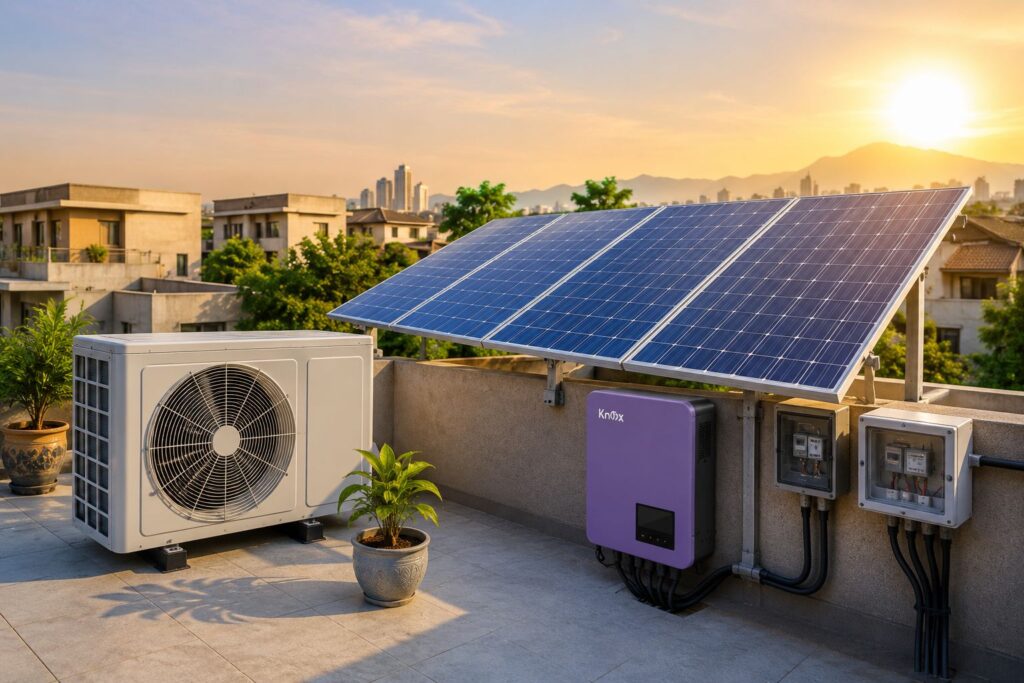
Thinking about running your 1.5-ton AC on solar but unsure how many panels you actually need? The answer depends on your AC’s power consumption, daily usage, and the type of solar system you choose. In this guide, we’ll break down real calculations, system sizes, and practical examples for Pakistani homes. By the end, you’ll know exactly which solar setup can reduce your electricity bills and deliver the best long-term savings.
If you own a modern 1.5-ton inverter AC, you typically need.
| Daily Usage | Recommended Solar Size | 550W Panels |
| 4–6 Hours | 3kW | 6 Panels |
| 6–8 Hours | 4kW | 7–8 Panels |
| 8–10 Hours | 5kW | 9–10 Panels |
| 10–12 Hours | 6kW | 11–12 Panels |
For most Pakistani households, a 5kW solar system offers the best balance between performance, savings, and future expansion.
Tired of High Electricity Bills? Choose Solar AC Systems
Pakistan’s electricity prices have increased significantly over the last few years. During summer, air conditioners become one of the biggest contributors to monthly electricity bills. A single 1.5 ton AC running for several hours every day can consume hundreds of electricity units each month.
This is why homeowners are increasingly turning to solar energy. A properly designed solar system can power an air conditioner during daylight hours while reducing dependence on grid electricity. Modern solar panels are more efficient than ever, making it possible to run high-consumption appliances such as air conditioners without dramatically increasing electricity costs.
Understanding What a 1.5 Ton AC Actually Means
Many people assume that the “1.5 ton” rating refers to electricity consumption.It does not.
The tonnage of an air conditioner represents its cooling capacity rather than the amount of power it uses.
When you use a solar system for running an AC. You cannot predict performance just on the basis of solar panels; you must keep in mind other factors, i.e room insulation, outdoor temperature, and the overall efficiency of the AC unit.
How Much Electricity Does a 1.5 Ton AC Consume?
Modern Inverter AC
Most modern inverter air conditioners consume between:
- 0.8kW and 1.8kW per hour
- Average operating consumption: 1.2kW to 1.5kW
Conventional Non-Inverter AC
Traditional non-inverter models typically consume:
- 1.8kW to 2.5kW per hour
- Average operating consumption: around 2kW
Because inverter technology continuously adjusts compressor speed, it can significantly reduce electricity usage compared to older fixed-speed units.
Real-Life Example Lahore Household
Consider a family in Lahore using a modern inverter AC.
System Details:
- 1.5 Ton Inverter AC
- Average Power Consumption = 1.4kW
- Daily Usage = 8 Hours
Calculation:
1.4 × 8 = 11.2 kWh
This means the AC uses approximately:
- 11 units per day
- 336 units per month
- More than 4,000 units per year
When electricity rates are high, these numbers can have a significant impact on household expenses.
How Solar Panel Calculations Work
Many websites oversimplify solar calculations.
The actual process involves three steps:
Step 1: Calculate Daily Energy Requirement
Formula:
Daily Energy Consumption = Power Consumption × Daily Usage
Example:
1.4kW × 8 Hours = 11.2kWh
Step 2: Calculate Solar Production
Pakistan receives approximately 5 to 6 peak sunlight hours daily.
A modern 550W solar panel can produce:
0.55 × 5.5 = 3.0kWh per day
Under ideal conditions.
Step 3: Account for System Losses
Real-world solar systems experience losses from:
- Dust accumulation
- High temperatures
- Cable resistance
- Inverter efficiency
- Seasonal weather changes
A safety margin of approximately 20–25% should always be included.
How Many Solar Panels Are Needed Based on Daily AC Usage?
4–6 Hours Daily
Recommended System:
- 3kW
- 6 Panels of 550W
Suitable for:
- Small families
- Limited AC operation
- Daytime cooling
6–8 Hours Daily
Recommended System:
- 4kW
- 7–8 Panels
Suitable for:
- Average households
- Regular summer usage
8–10 Hours Daily
Recommended System:
- 5kW
- 9–10 Panels
Suitable for:
- Heavy AC users
- Multiple household appliances
10–12 Hours Daily
Recommended System:
- 6kW+
- 11–12 Panels
Suitable for:
- Larger homes
- Extended cooling requirements
How Panel Wattage Changes the Number of Panels Required
Not all solar panels generate the same amount of electricity.
| Panel Size | Panels Needed |
| 450W | 8–12 |
| 550W | 6–10 |
| 585W | 6–9 |
| 650W | 5–8 |
Higher-wattage panels can reduce roof space requirements while increasing energy production.
Best Solar System Size for Running a 1.5 Ton AC
3kW Solar System
Best For:
- Daytime AC usage
- Small homes
- Limited electricity demand
5kW Solar System
Best For:
- Most Pakistani households
- Regular AC operation
- Additional household appliances
10kW Solar System
Best For:
- Multiple AC units
- Large homes
- Maximum savings through net metering
Can a 5kW Solar System Run a 1.5 Ton AC?
Yes.
A properly designed 5kW system can usually operate:
- One 1.5 ton inverter AC
- Refrigerator
- Fans
- Lights
- Television
- Internet devices
during daylight hours.
This is one of the reasons 5kW systems remain among the most popular residential solar installations in Pakistan.
On-Grid vs Hybrid Solar Systems
On-Grid Solar
Advantages:
- Lower installation cost
- Net metering benefits
- Higher efficiency
Best for homeowners with stable electricity supply.
Hybrid Solar
Advantages:
- Battery backup
- Protection during load shedding
- Night-time operation
Best for areas experiencing frequent power interruptions.
Factors That Affect Solar Panel Requirements
Sunlight Availability
Cities such as Lahore, Islamabad, Rawalpindi, Multan, Faisalabad, Karachi, and Bahawalpur receive strong solar irradiance throughout much of the year.
Roof Direction
South-facing roofs typically achieve the highest solar production in Pakistan.
Temperature
High temperatures can slightly reduce panel efficiency.
Air Conditioner Efficiency
More efficient inverter models require fewer solar panels.
Future Electricity Needs
Always consider future appliances before finalizing your system size.
Common Mistakes Homeowners Make
- Selecting a solar system based only on AC tonnage.
- Ignoring actual power consumption.
- Choosing low-quality inverters.
- Underestimating future electricity usage.
- Failing to account for system losses.
- Prioritizing the cheapest option over long-term performance.
Frequently Asked Questions
How many solar panels are enough for a 1.5-ton inverter AC?
Most households require between 6 and 10 modern 550W solar panels depending on daily usage and system efficiency.
Can a 3kW solar system run a 1.5 ton AC?
Yes, for moderate daytime use. However, households with longer operating hours often benefit from a larger system.
Is a 5kW solar system enough for a 1.5 ton AC?
Yes. A properly designed 5kW system can comfortably run a 1.5 ton inverter AC alongside several household appliances during the day.
Do I need batteries to run my AC on solar?
Not necessarily. On-grid systems can power your AC during daylight hours. Batteries are only required if you want backup power during load shedding or night-time operation.
Which solar panels are best for air conditioners in 2026?
High-efficiency N-Type TOPCon panels are among the most popular options because they offer better performance, lower degradation, and improved energy production in hot climates.