


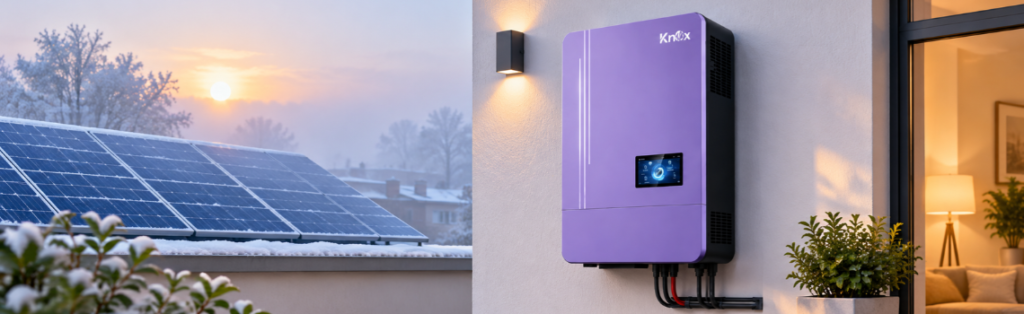
Buy Knox Hybrid Inverter for Winter
Winter changes how a house uses electricity. The sun rises late and sets early, fog sits over the Punjab plains for days, and snow settles on panels in the north. Inside, the geyser runs longer, the room heater stays on, and the kitchen works through the evening. Output drops while demand climbs, and a system designed only for summer starts to feel the strain.
This is where a Knox hybrid inverter for winter earns its place. It stores the energy your panels collect, hands it back during the busy evening hours, and keeps your essential loads running when the grid drops. In this guide we explain how winter affects a solar system, which Knox hybrid models suit which homes, what to check before you buy, and where our on-grid range fits alongside.
Why Winter Is the Real Test for a Solar System
Most people judge solar in summer, when generation is easy. Winter shows whether a system was designed properly.
Shorter Days and a Lower Sun
In December and January you get fewer productive hours, and the low sun angle means panels catch less direct light. Cloud, fog and smog cut generation further. A system that comfortably covers your load in June may fall short in January.
Heavier Evening Demand
Your highest winter load usually arrives after sunset: electric heaters, water geysers, kitchen appliances and lighting for long evenings. Where gas supply is unreliable, even more cooking and heating shifts to electricity. If your inverter only works while the sun shines, that demand lands on the grid.
Grid Instability Does Not Take a Holiday
Voltage fluctuation and outages are common when demand peaks across the network. A grid-tied system without storage switches off during an outage by design, which leaves you without power at exactly the time you need heat and light.
Cold Changes Panel Behaviour
There is a technical point many buyers miss: solar panel voltage rises as temperature falls. On a cold, clear morning a string can produce noticeably higher voltage than it does at midday in summer. If the string was designed to sit close to the inverter’s input limit, a cold morning can push it over. Good system design accounts for the coldest expected morning, not an average day. We return to this in the sizing section below.
What a Hybrid Inverter Does Differently
A standard on-grid (grid-tied) inverter converts solar DC power into AC power for your home and the grid. It is simple, efficient and cost-effective, but it has no storage and shuts down when the grid fails.
A hybrid inverter does the same conversion and adds three abilities:
- Battery charging: surplus daytime solar goes into the battery instead of being wasted or exported.
- Backup supply: when the grid fails, the inverter switches to the battery and keeps your chosen loads running.
- Smart source selection: it decides, moment by moment, whether to use solar, battery or grid, based on your load and settings.
In winter the first point matters most. Solar produces less, so every unit you store is worth more. Using stored energy during the 6 pm to 10 pm peak is how a hybrid system turns a weak winter day into a manageable one.
The Knox Hybrid Range for Winter Use
Our hybrid inverters sit under Residential Energy Storage. The range covers single-phase and three-phase homes, and every listed model supports grid feeding. Here is how the main series fit different winter situations.
Knox Zynex Series: Single-Phase Homes and Small Shops
The Zynex Series is a single-phase hybrid inverter with grid feeding and IP54 protection, built for residential and small commercial use. Models run from ZX-3M-0816 to ZX-3M-1020.
What makes it practical in winter:
- Dual MPPT trackers: two independent inputs let you connect panels facing different directions, such as east and west roof sections. When light is limited, harvesting from both orientations helps you collect more across the day.
- Grid and battery switching: it moves between sources without you doing anything.
- Load prioritisation: you decide which loads get power first, so a heater or fridge is never starved by a lower-priority appliance.
- Wi-Fi and RS485 communication: view generation, consumption and battery status through the mobile app or web portal.
- Operating range of -25°C to +60°C: it is rated for cold mornings as well as hot summer afternoons.
- Compact build: at 34.5 kg it suits wall mounting in a utility room or garage.
For a typical 5 to 10 marla house with fans and ACs in summer and heaters and a geyser in winter, this is the series most owners start with.
Knox Xenon 12066: A Step Up for Larger Single-Phase Loads
The Xenon 12066 is a single-phase hybrid inverter with grid feeding and IP54 protection. If a smaller unit feels tight for a home with several heaters, a deep freezer, a water pump and a workshop connected, this is the next size to look at.
Knox Xenon 18000 and 22500: Three-Phase and Heavy Winter Loads
Large homes, farmhouses, clinics, guest houses and small offices often run on three-phase supply. The Xenon 18000 & 22500 is a three-phase hybrid inverter with grid feeding and IP66 protection. That rating matters in winter, when fog, rain, dust and condensation are normal. An enclosure built for those conditions gives you more margin for outdoor or semi-outdoor mounting.
Knox Krypton Series: Flexible Mid-Range Options
The Krypton family covers several output levels: Krypton 9000, Krypton 9055 and the Krypton 12002 | 13002 | 15002. All are hybrid inverters with grid feeding. They suit homeowners who want more headroom than a basic residential unit without moving up to the three-phase class.
6.6 kW and 9.2/11.2 kW IP54 Models
For households that fall between sizes, we also offer the 6.6kW-12000pV and the 9.2kW & 11.2kW, both with IP54 protection. The right choice depends on your PV array size and battery voltage, so our team will confirm the match before you order.
Powerwall and Rack-Mount Batteries
An inverter is only half of a winter system. The battery decides how long you stay powered after sunset. We pair our inverters with the Powerwall IP20, the Powerwall IP54 and the Rack-Mount Series. The IP54 version is the safer pick for garages, verandas or semi-outdoor locations where moisture is a concern. The IP20 version suits clean, dry indoor spaces.
Winter-Ready Features to Check Before You Buy
Not every inverter handles winter equally well. Use this checklist when you compare models.
1. Dual MPPT Inputs
Winter light is weaker and more uneven. Shadows from a neighbour’s building, a water tank or a boundary wall stretch longer across the roof. Two MPPT inputs let each panel group work at its own best point, so one shaded string does not drag the other down.
2. A Wide MPPT Voltage Window
A wide operating window lets the inverter keep harvesting early in the morning and late in the afternoon, when voltage is low, and in cold, bright conditions, when voltage is high. Check both ends: the minimum start-up voltage and the maximum input voltage.
3. Ingress Protection (IP Rating)
Dust, fog, rain and condensation all increase in winter. IP54 handles dust and splashing water. IP66 is built for stronger water exposure. Match the rating to where the unit will hang, not just to the brochure.
4. Operating Temperature Range
Look for a stated range that covers your coldest nights. Our Zynex and G4 Pro product pages list -25°C to +60°C, which covers both a northern winter and a plains summer.
5. Load Prioritisation
You want control over what the battery feeds first. The fridge, lights, Wi-Fi router and a heater in the main bedroom should outrank a washing machine.
6. Live Monitoring
In winter your daily yield can swing widely between a clear day and a foggy one. App-based monitoring shows you what happened, so you can adjust usage instead of guessing.
7. Protection Features
Reverse polarity protection, short-circuit protection and surge protection guard your equipment during storms and unstable grid conditions. They cost little compared with what they protect.
What Our On-Grid Range Shows About Winter Performance
Our on-grid inverters are listed separately, and they are worth understanding even if you plan to buy a hybrid. They show the same engineering priorities and help you decide whether you need storage at all.
Residential On-Grid: Xerox G4 Series and G4 Pro
The Residential OnGrid Inverter category lists the Xerox G4 Series 10KW and the Xerox G4 Pro (5KW – 25KW). Both are three-phase units.
The G4 Pro gives a clear picture of what a well-specified inverter looks like:
- Dual MPPT design for flexible roof layouts
- Maximum input voltage of 1100 V, which leaves generous room for cold-morning voltage rise
- MPPT range of 150 V to 1000 V, so it keeps working across a wide band
- Operating temperature of -25°C to +60°C
- Live performance tracking through remote management
- Custom export limitation settings, useful where grid export rules apply
- Reverse polarity and short-circuit protection, with optional Type II surge protection
- Weight of 16 to 18.6 kg depending on model, so wall mounting is straightforward
Commercial and Industrial On-Grid: Xerox G4 Pro
For factories, schools, hospitals, cold stores and farms, the C&I OnGrid Inverter range includes the Xerox G4 Pro 30kW, 40–50kW, 60kW and 100–125kW.
Hybrid or On-Grid: How to Decide
Choose on-grid if:
- Your area has stable supply and few outages.
- Most of your consumption happens during the day, as in offices, shops and factories.
- You want the lowest upfront cost and the fastest payback.
- Your utility offers a buyback arrangement that suits you (check current terms with your distribution company, as rules change).
Choose hybrid if:
- You face regular outages or voltage problems.
- Your heaviest load falls in the evening or early morning.
- You depend on electricity for heating, water, and medical or work equipment.
- You want to cut grid use during peak hours.
Consider a layered approach if you run a commercial site with heavy daytime load and also need critical backup. A large on-grid inverter can carry the daytime load while a hybrid unit with a battery protects essential circuits.
How to Size a Hybrid System for Winter
The most common mistake is sizing for summer. Use winter figures instead.
Step 1: List Your Winter Loads
Write down every appliance you use between October and February, with its wattage and daily hours. Include the geyser, heaters, blower, water pump, fridge, lights, fans, TV, laptops and router. Be honest about how long each one runs.
Step 2: Work Out Daily Energy in kWh
Multiply watts by hours, add everything up, and divide by 1,000. This is your daily energy need. Many homes find the winter total is lower than summer, but with a very different shape: more in the evening and morning, less at midday.
Step 3: Decide What Must Run During an Outage
You rarely need to back up the whole house. Pick the essentials: lights, fans or a heater, the fridge, the router, phone charging and the pump. This keeps battery size sensible.
Step 4: Size the Battery for the Evening Gap
Your battery should cover the hours between sunset and the next day’s generation, with a margin for foggy days. If you plan to run a heater from the battery, allow more capacity, because heaters draw heavily.
Step 5: Size the Panel Array for a Poor Winter Day
Your panels need to generate enough on a weak winter day to recharge the battery and run daytime loads. A slightly larger array than a summer-only design costs less than missing a battery recharge during a foggy week.
Step 6: Check String Voltage at the Coldest Temperature
This step protects your inverter. Your installer should calculate string open-circuit voltage at the lowest expected temperature and confirm it stays below the inverter’s maximum input. The Zynex, for example, lists a 550 V maximum input and a 40 V to 530 V MPPT range, so the string design must respect those figures on the coldest morning.
Practical Winter Habits That Stretch Your System
Hardware helps, but how you use it counts too.
- Shift flexible loads to midday. Run the washing machine, iron and water pump while the sun is strongest.
- Heat water while the sun is out. If you use an electric geyser, set it to heat in the early afternoon so the battery is not drained at night.
- Keep panels clean. Winter dust, bird droppings and the film left by fog cut output. A soft rinse every couple of weeks pays back quickly.
- Clear snow gently. In northern areas, tilt panels to a steeper angle and brush snow off with a soft tool. Never use anything sharp or hard.
- Watch the app. Check daily yield and battery level, and adjust load priority on poor-weather days.
- Seal and insulate. Less heating demand means less battery draw. A well-sealed room reduces the heater’s workload.
- Service before the season. Check cable connections, mounting and battery health in October, not in the middle of a cold snap.
Common Winter Mistakes to Avoid
- Buying on price alone. The cheapest inverter often has a narrow voltage window, a low IP rating or limited protection.
- Undersizing the battery. A battery that lasts two hours does little for a four-hour evening peak.
- Ignoring string design. Cold-morning voltage can exceed an inverter’s input limit if nobody checks it.
- Mounting in the wrong place. Match the IP rating to the actual location. IP20 batteries belong indoors.
- Skipping monitoring. Without data you cannot tell whether a poor day is the weather or a fault.
- Choosing the wrong type. Pick hybrid or on-grid based on your real needs, as set out above.
Why Homeowners and Businesses Choose Knox
At Knox Solar our aim is to make solar energy practical, efficient and affordable. A few things set our range apart:
- A full product ladder: from single-phase residential hybrids to three-phase IP66 units, plus on-grid and C&I inverters up to 125 kW.
- Clear specifications: each product page lists voltage ranges, temperature range, dimensions and weight, with data sheets to download.
- Monitoring built in: Wi-Fi and RS485 communication come with the models featured here.
- Matched storage: Powerwall and rack-mount batteries sit alongside the inverters, so you can plan inverter and battery together.
To learn more about who we are, visit our About Us page.
Frequently Asked Questions
Does a Knox hybrid inverter work in cold weather?
Our Zynex and Xerox G4 Pro product pages list an operating temperature range of -25°C to +60°C, which covers typical winter conditions in Pakistan. Always confirm the exact range for your chosen model on its data sheet.
Will my solar system produce less in winter?
Usually, yes. Shorter days, a lower sun angle, fog and cloud all reduce generation. That is why winter sizing, battery storage and smart load use matter.
Can a hybrid inverter run my heater and geyser?
It depends on the inverter’s rated output, the battery capacity and what else is running. Heaters and geysers draw heavily, so most owners run one heater from the battery and heat the geyser during daytime solar hours.
What is the difference between IP54 and IP66?
Both ratings protect against dust, but IP66 gives stronger protection against water jets. Choose based on where the unit will be mounted. The Zynex and Xenon 12066 carry IP54, and the Xenon 18000 & 22500 carries IP66.
Is an on-grid inverter enough for winter?
If your grid supply is reliable and most of your load falls in daylight hours, yes. If you face outages or evening-heavy demand, a hybrid inverter with a battery makes more sense.
Can I add a battery later?
Many homeowners start with a hybrid inverter and add storage afterwards. Speak with our team about compatible batteries before you buy so that voltage and communication match.
Which Knox model suits a three-phase home?
The Xenon 18000 & 22500 is our three-phase hybrid option. For grid-tied three-phase use without storage, look at the Xerox G4 Pro range.
Final Thoughts
Winter does not mean solar stops working. It means the margins are thinner and good design matters more. A hybrid inverter lets you save the sun’s energy for the hours you need it most, keeps essentials running through outages, and gives you the data to manage your power use.
Start with your real winter loads, choose an inverter whose voltage window and protection suit your climate, pair it with the right battery, and have the string design checked for the coldest morning. Browse the full Knox product range, read our FAQs or visit the Knox blog for more guides.
Ready to size a system for your home or business? Contact the Knox Solar team with your winter load list and roof details, and we will recommend the right hybrid inverter and battery combination before the cold arrives.