


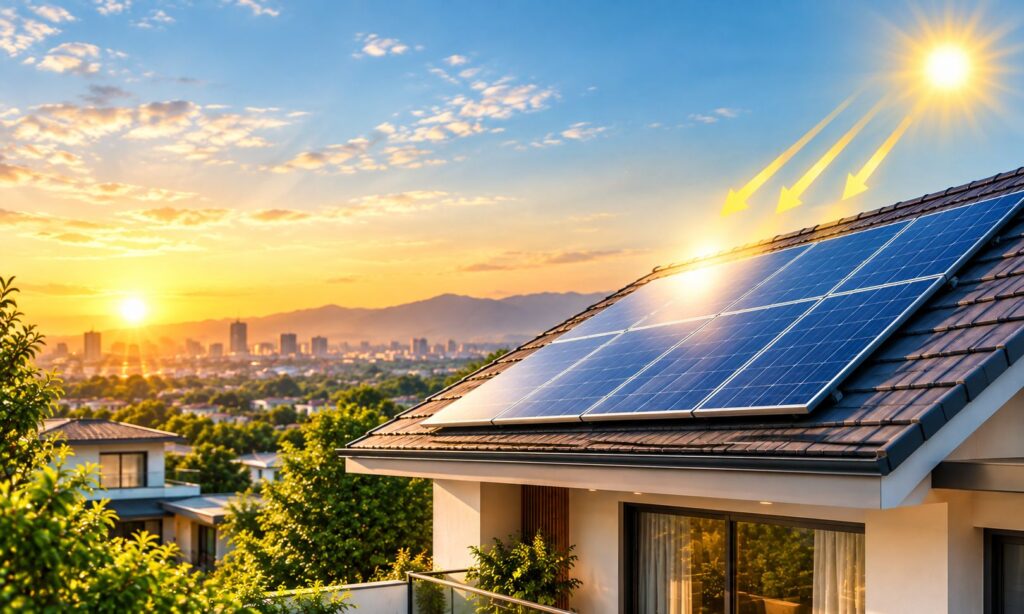
A Better Roof Means Better Solar Performance
Think of your roof as the foundation of your solar system.If it’s optimized, your system performs at its peak.If it’s poorly planned, you lose efficiency every single day.
We’re not talking small differences either.A poorly aligned or shaded roof can reduce your energy production by 20% to 40%. That’s thousands of rupees lost every year.
On the other hand, the right roof setup:
- Maximizes solar output
- Improves system lifespan
- Reduces maintenance issues
- Unlocks the full potential of hybrid systems
Direction Matters More Than You Think
In Pakistan, sunlight is your biggest advantage but only if your panels face the right direction.
Best direction: South-facing
This allows you the greatest amount of sunlight exposure during the day, thus generating the most electricity.
Roofs that face east and west are still usable, but won’t be as productive as a roof on the south. North-facing roofs? This is where efficiency starts to become a real challenge.
Here’s the reality:
Even the best inverter can’t fix poor sunlight exposure.
Yes, advanced systems like Knox can optimize performance but they can’t create sunlight where it doesn’t exist.
The Right Angle = More Power
The angle (tilt) of your roof determines how directly sunlight hits your panels.
In Pakistan, the sweet spot is around 25 to 30 degrees.
Why does this matter?
Because:
- Better angle = more direct sunlight
- More sunlight = higher energy production
- Higher production = faster ROI
If you have a flat roof (which is common), don’t worry. Mounting structures can adjust the angle but that adds cost. A naturally tilted roof already gives you an advantage.
Not All Roofs Are Solar-Friendly
Here’s where things get practical.
Concrete Roofs (Best Option)
Most homes in Pakistan have concrete roofs and that’s actually perfect for solar.
They’re:
- Strong
- Durable
- Ideal for heavy systems
- Easy to install on
If you’re planning a hybrid setup with batteries and a powerful inverter, concrete roofs handle it easily.
Metal Roofs (Also Excellent)
Metal sheet roofs are lightweight but surprisingly solar-friendly.
Installers can use clamps instead of drilling, which:
- Speeds up installation
- Reduces damage risk
- Keeps things clean and efficient
Tile Roofs (Risky)
Tile roofs look good—but they’re fragile.
Installation becomes tricky, and there’s always a risk of breakage. That means:
- Higher labor cost
- More maintenance issues
Weak or Old Roofs (Avoid)
If your roof has cracks, damage, or weak structure, installing solar is risky.
Solar panels typically weigh 15–25 kg each. A full system adds significant load.
Before installing anything:
- Get your roof inspected
- Fix structural issues
- Reinforce if needed
Skipping this step can cost you way more later.
Shading The Silent Energy Killer
This is one of the biggest mistakes homeowners make.
They install panels without considering shadows.
And even a small shadow from a water tank, tree, or nearby building can drastically reduce output.
Here’s why:
Solar panels work in connected strings. If one panel is shaded, it affects the performance of others too.
So your roof should be:
- Open
- Clear
- Free from obstructions
Yes, modern inverters like Knox help reduce shading losses but again, they can’t fully fix poor placement.
Space Planning Think Ahead
Most people plan their solar system according to their needs today.
That’s short-term thinking.
Electricity prices are going up. Usage is increasing. All add load: ACs,appliances, devices.
So what happens?
Within a year, the people wish to extend their system.
But by then:
There is limited roof space available.
Layout is fixed
Expansion becomes difficult
Smart move?
Plan for the future from day one.
Leave extra space. Design properly. Choose a system that can scale like Knox hybrid inverters.
Heat & Ventilation The Hidden Factor
Pakistan’s heat is no joke.
And here’s something most people don’t know:
Solar panels lose efficiency when they get too hot.
If your panels are installed too close to the roof with no airflow, heat builds up and performance drops.
A good installation includes:
- Proper mounting height
- Air gap for ventilation
- Smart layout design
This is where professional installation matters.
Aesthetics vs Performance
A lot of homeowners worry about how solar panels will look.
Fair concern but don’t let it ruin your system design.
Solar isn’t just about looks it’s about performance and savings.
That said, you can have both:
- Clean panel layout
- Symmetrical design
- Modern black panels
The key is choosing the right installer who understands both engineering and design.
Final Checklist Before You Install Solar
Before you go ahead, make sure your roof meets these conditions:
- Faces south (or close to it)
- Has proper tilt (or adjustable mounting)
- Strong and damage-free
- Minimal shading
- Enough space for expansion
- Good airflow setup
Conclusion
You can invest in the best solar panels.
You can install a powerful inverter like Knox.
You can add top-tier lithium batteries.
But if your roof isn’t right
You’ll never get the results you expect.
Think of your solar system like this:
- Panels = Power generation
- Inverter = System control
- Roof = Performance foundation
And foundations aren’t something you ignore.